
Vaccine Hesitancy: a World of Misinformation
Image from Leigh Prather/Shutterstock.com
With this winter’s flu season approaching, healthcare providers and public health officials are once again grappling with vaccine hesitancy among their patients, an issue that impacts not only individual health, but also collective wellbeing. This week, we will discuss the origins and progression of this hot topic, one ridden with misinformation and strong emotions.
In 1998, Dr. Andrew Wakefield and colleagues published a paper suggesting a link between the measles, mumps, and rubella (MMR) vaccine and the consequent development of autism. The infamous Wakefield Article specifically hypothesizes that the MMR vaccine caused intestinal inflammation that allowed proteins to enter the bloodstream and subsequently the brain. These proteins were suspected to cause a variety of developmental issues, including autism. The study supported such claims with a cohort of 12 children with developmental delay, 8 of which had autism. Each of these children had intestinal symptoms and developed autism within one month of receiving the MMR vaccine.
The Wakefield paper was retracted in 2004 as it was evidently based in scientific misconduct with fraudulent claims from misrepresented data. One of the many issues of this study design, as noted by Gerber in his literature review was that the self-referred cohort didn’t include unvaccinated control subjects. Therefore, it is impossible to determine a causal rather than coincidental relationship between the MMR and autism. In fact, about 90% of children in England receive the MMR vaccine between ages one and two, which corresponds to the age when autism typically presents and is diagnosed. Another major flaw with the paper was that authors claimed autism to be a consequence of intestinal inflammation. However, in reality the intestinal symptoms were observed after the symptoms of autism in all eight cases. Lastly, the participant assessments were not blind and the data was not collected systematically, causing the data to be riddled with bias.
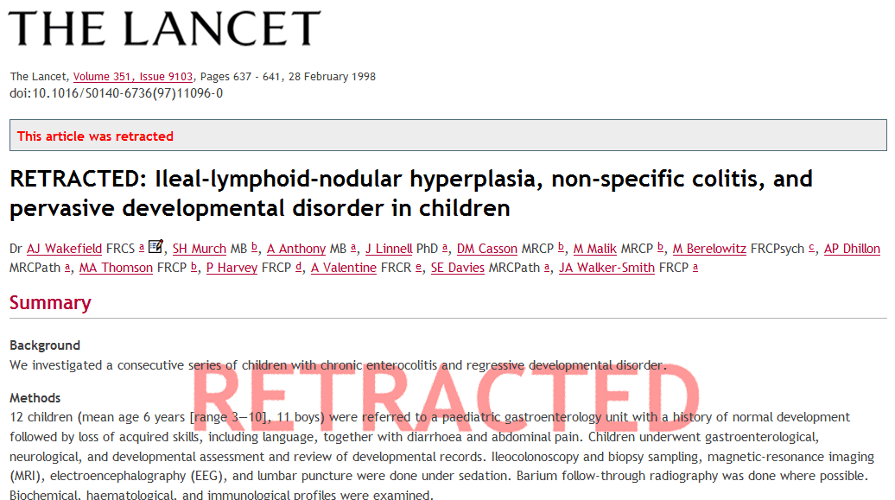
Despite being retracted by the Lancet in 2010, Vaccine skepticism wildly increased following the publication of the Wakefield et al study. In fact, there was an immediate increase of 70 MMR injury claims per month. The public health impact has been widespread, with vaccine rates dropping in many countries. However, this fraudulent research has been disproven by numerous legitimate studies across multiple countries over the years. According to Gerber, by 2010, there were 20 studies of varying designs and locations that failed to support an association between the MMR vaccine and Autism.
One study linked hospital records to vaccination records of 537,303 children born in Denmark from 1991-1998. This large observational study by Madsen et al. included both vaccinated and unvaccinated subjects to strongly disprove the hypothesis of Wakefield. Finland researchers analyzed a cohort of MMR-vaccinated children from 1982-1996 and found 31 children with gastrointestinal symptoms and no vaccine-associated autism cases among 1.8 million children. This large prospective follow-up established that adverse outcomes of the MMR vaccine are extremely rare. Combined with the biological implausibility that the vaccine causes developmental delay, the statistical power of such studies with large cohorts have debunked the notion that vaccines cause autism. Therefore, the risks of measles, mumps, and rubella diseases themselves are much more dangerous than the vaccine.

In the wake of the COVID-19 pandemic, numerous false claims circulated the media raising fear of the newly developed vaccines. Conspiracy theorists claimed that the vaccines contained microchips for tracking and others raised unsupported concerns that the vaccine would cause infertility and pregnancy complications. Another widespread fear was that the COVID-19 vaccine could change human DNA. This claim gained traction through social media posts, anti-vaccine activists and celebrities, and even the misinterpretation of a 2021 published study that showed viral RNA can be reverse-transcribed and integrated into the genome of infected cells.
In response, experts explained that the mRNA vaccine “instructs the body to produce a protein found on the surface of the corona virus so that the immune system may learn to recognize and produce antibodies against this protein.” In disproving the claim, doctors and scientists note that the RNA doesn’t enter the nucleus at all and therefore doesn’t even come in contact with genetic material. Furthermore, research suggests that vaccine mRNA completely degrades within days. Large-scale clinical trials have also shown no evidence of genetic changes following COVID-19 vaccination, further supporting the biological and technical reasons why this is impossible. After all, for those of us vaguely familiar with biochemistry, we know that RNA and DNA have an entirely different chemical structure! This disproven claim, among the plethora of COVID-19 misinformation, emphasizes the importance of scientific literacy and public health communication

 Blair Tilley Microbiology